Developer standard in Poland: what you get and what finishing costs in 2026
What a flat in stan deweloperski usually includes, what you still have to do, 2026 finishing costs per m² and per task, and how to check it all at handover.
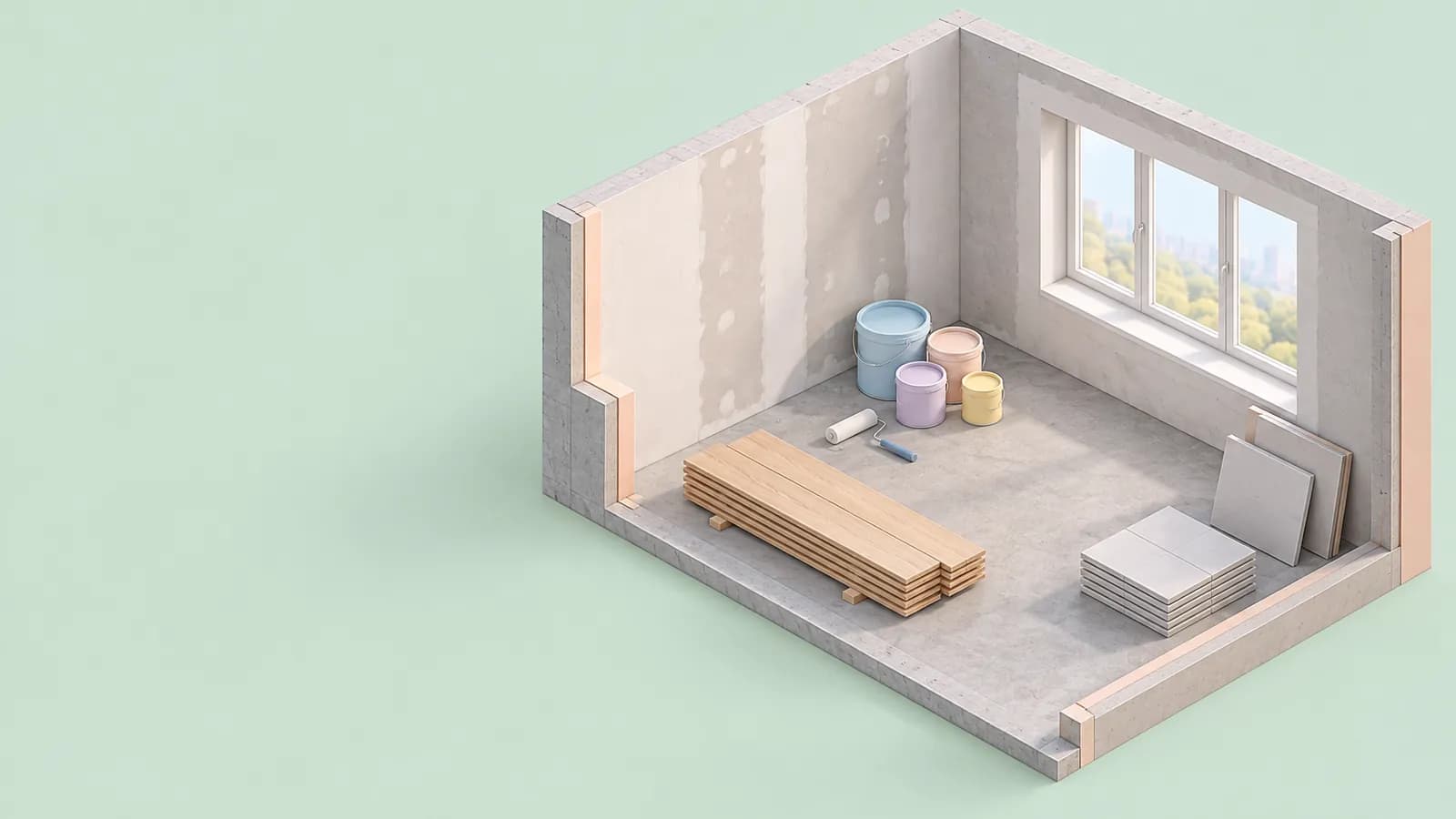
Most new flats in Poland are sold in developer standard, stan deweloperski. It is a shell that is ready for finishing, not a flat you can move into. The difference between the two is usually the largest cost on top of the price, and the one buyers underestimate most often. This guide explains what developer standard normally includes, what finishing costs in 2026, and how to protect yourself at handover.
What developer standard usually includes
There is no legal definition. Each developer describes its standard in the information prospectus and in the contract, often in an annex. Typically you get:
- walls and ceilings plastered, ready for skim coat and paint;
- floors with a cement or anhydrite screed, without any floor covering;
- windows and a balcony door, with sills;
- an entrance door, often with a lock and an intercom;
- electrical wiring to sockets and switches, and wires left for lights;
- water and sewage points capped where the bathroom and kitchen will go;
- heating, either radiators or underfloor heating;
- ventilation, usually gravity or mechanical exhaust.
What you usually still need: skim coat and painting, floors and skirting, interior doors, bathroom tiles and fittings, the kitchen, lights and built-in furniture.
Read the annex line by line. Some developers include painted walls or bathroom tiles; others leave out sockets or radiators in some rooms. Two flats called "developer standard" can differ by tens of thousands of złoty in finishing costs.
What finishing costs in 2026
There is no official statistic for finishing costs, so the figures below come from market guides published in 2026. They disagree, partly because some include materials and others do not. Treat them as ranges, not quotes.
Turnkey cost per m² of flat, labour and materials (ilezametr.pl, 2026):
| Standard | Poland overall | Warsaw | Kraków | Wrocław |
|---|---|---|---|---|
| Economy | zł 1,200–1,600 | zł 1,500–1,800 | zł 1,400–1,700 | zł 1,350–1,650 |
| Mid-range | zł 1,600–2,200 | zł 1,900–2,500 | zł 1,800–2,400 | zł 1,750–2,300 |
| Premium | zł 2,200–3,200 | zł 2,600–3,500 | zł 2,500–3,300 | zł 2,400–3,200 |
Oferteo, another 2026 guide, puts economy finishing from about zł 1,800/m² and premium above zł 3,500/m², and reports a rise of 10–15% compared with 2025. Labour alone is usually quoted at zł 700–1,500 per m² of floor area.
Selected labour rates, without materials (Oferteo, January 2026):
| Task | Typical rate |
|---|---|
| Two coats of paint | zł 20–35/m² |
| Full skim coat | zł 45–65/m² |
| Standard tiles | zł 100–160/m² |
| Laminate with skirting | zł 35–55/m² |
| Interior door with frame, fitting | zł 300–450 per door |
Selected materials: laminate zł 60–120/m², bathroom tiles zł 80–150/m², an interior door with frame and handle zł 1,200–1,800, kitchen cabinets zł 1,800–3,000 per running metre without appliances, and at least zł 4,000–6,000 for bathroom fittings.
A 50 m² example
For a 50 m² flat in a mid-range standard, the two guides give:
- ilezametr.pl: zł 80,000–110,000 turnkey;
- Oferteo: zł 90,000–130,000.
Add 10–15% for contingencies, and furniture and appliances on top. A realistic budget for a mid-range two-room flat is therefore about zł 90,000–150,000 including a reserve, before furniture. Our existing guide to the full cost of buying a new build uses a similar range, and the calculator adds finishing to notary and court fees.
VAT tip. Work on a flat of up to 150 m² done by a contractor is usually taxed at the reduced 8% VAT rate, including materials the contractor supplies as part of the service. Materials you buy yourself in a shop carry 23%. Ask your contractor how they will invoice.
How long it takes
For a 50 m² mid-range finish, ilezametr.pl estimates 8–12 weeks of work: installations and drywall, then tiling, skim coat and painting, then floors, doors and fittings. Premium finishes can take four to six months. Good crews are often booked months ahead, so start looking before handover.
Before handover: changes and timing
- Layout changes (zmiany lokatorskie). Many developers let you move walls, sockets or plumbing points during construction, usually for a fee and before a set stage. It is cheaper than changing things later.
- Turnkey packages. Some developers sell finishing packages. Compare the price per m² and the list of materials with independent quotes.
- Timing with your mortgage. If you rent while you finish, every month of delay costs rent plus the mortgage. A realistic schedule saves money.
At handover: your rights
Handover (odbiór) happens after the occupancy permit is final. Under article 41 of the Developer Act:
- You inspect the flat in person and sign a protocol, where you list all defects.
- The developer has 14 days from signing to send you, on paper or another durable medium, either acceptance of the defects or a reasoned refusal. If it does not answer, the defects are deemed accepted.
- Accepted defects must be fixed within 30 days of signing the protocol. If the developer cannot meet that, it must give a new date with reasons; if it misses that too, you set a final date and may then fix the defects at the developer's cost.
- You can refuse handover if you find a material defect, which is noted in the protocol.
Bring the finishing-standard annex, a tape measure, a spirit level, a socket tester and a list. Check the area against the contract: since February 2026 the price is set as area times price per m², so a difference in area changes the price.
Bottom line
Developer standard is a starting point, not a finish. When you compare flats, add the finishing budget to the price per m² and read what each developer actually includes. Havkey shows each project's checks with dates, so you can compare the projects as well as the flats. Start in the catalogue, and read how to read a developer's price list before you sign.
Questions
Is developer standard defined by law?
No. Polish law does not define it. What you get is described in the information prospectus and the developer contract, often in an annex on the finishing standard. Read it before you sign.
How much does finishing a 50 m² new flat cost in 2026?
Roughly zł 80,000–130,000 for a mid-range standard with materials, according to 2026 market guides, and from about zł 60,000–70,000 for an economy finish. Furniture and appliances are extra. Get several quotes for your own flat.
How long does finishing take?
For a 50 m² flat in a mid-range standard, about 8–12 weeks of work, plus time to find a contractor. Plan it before handover so you do not pay rent and a mortgage at the same time for longer than necessary.
What happens to defects I find at handover?
You list them in the handover protocol. The developer has 14 days to accept or reject them in writing, and silence counts as acceptance. Accepted defects must be fixed within 30 days of signing the protocol.
Sources
- 1.Developer Act, consolidated text, art. 41 on handover and defects (Dz.U. 2026 poz. 880)
- 2.VAT Act, consolidated text, art. 41 ust. 12–12c (Dz.U. 2026 poz. 1263)
- 3.ilezametr.pl: How much does finishing a flat cost in 2026, complete guide
- 4.Oferteo: Cost of finishing a flat per m² in 2026 (updated 4 May 2026)
General information, not financial or legal advice. Check figures with the cited sources before you decide.
Looking for a new apartment?
Compare checked new-build projects with dated construction photos and the full cost of purchase.